Institutional Risk Lens: Why Liability, Unwind, and Jurisdiction Matter More Than UX
Tokenization has moved from concept to implementation across private markets, structured products, funds, and alternative assets. As interest matures, so do the evaluation criteria applied by institutional participants. Features that may appeal to early adopters, for example, intuitive interfaces, rapid deployment, or abstracted complexity, rarely determine whether a tokenization initiative proceeds inside a regulated institution.
At the institutional level, tokenization is not assessed as a product experience. It is assessed as a risk-bearing financial structure. Decisions are shaped by liability exposure, enforceability under law, operational failure scenarios, and jurisdictional clarity. User experience may influence adoption at the margins, but it does not mitigate balance-sheet, legal, or regulatory risk.
UX Is Not a Risk Control
Consumer-facing crypto products conditioned the market to treat usability as a proxy for maturity. For institutions, the opposite is often true. Simplified interfaces frequently obscure underlying legal and operational dependencies that matter most when systems are stressed.
A clean UX does not answer fundamental questions such as:
- Who is legally responsible if asset servicing fails?
- What happens if the tokenization provider becomes insolvent?
- Which jurisdiction governs disputes or enforcement?
- How are ownership rights asserted outside the platform?
Institutions operate within defined risk frameworks. Any structure that cannot be clearly mapped to those frameworks, regardless of how intuitive it appears, introduces uncertainty that compliance and legal teams cannot absorb.
Liability Allocation in Tokenized Structures
One of the most overlooked risks in tokenization is ambiguous liability. Many tokenization platforms bundle issuance, custody logic, compliance tooling, and lifecycle management into a single technical layer. While efficient in appearance, this consolidation can blur accountability.
Institutions require clear answers to:
- Which entity bears liability at each stage of the asset lifecycle?
- How are roles separated between issuer, infrastructure provider, administrator, and custodian?
- What contractual recourse exists if one party fails to perform?
From a risk perspective, opacity is unacceptable. Institutions favor architectures where responsibilities are explicit, legally defined, and enforceable. Liability must be allocable, auditable, and defensible in regulatory review. Any model that relies on implicit trust in a platform operator introduces structural risk that cannot be diversified away.
Unwind, Recovery, and Failure Scenarios
Institutional asset tokens differ materially from native crypto assets. Where tokenized assets are issued through compliant legal structures, such as registered transfer agents or recognized ownership registries, the token itself is a representation of ownership, not the ownership record. In such cases, replacement, correction, or reissuance is both feasible and expected.
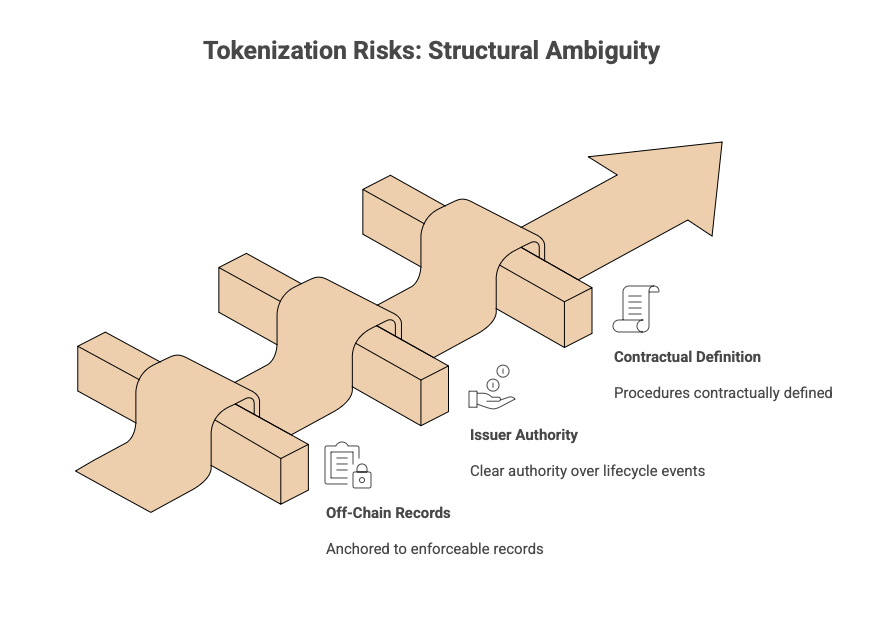
However, this capability is not inherent to tokenization. It is the result of deliberate legal and operational design. Institutions therefore assess whether tokenized assets are anchored to enforceable off-chain records, whether issuers retain clear authority over token lifecycle events, and whether replacement or unwind procedures are contractually defined rather than technically implied.
The risk institutions seek to avoid is not token failure, but structural ambiguity, where ownership, records, or recovery mechanisms depend on continued platform operation or discretionary intervention. Recovery, auditability, and legal continuity must persist even in scenarios involving provider failure, contractual termination, or regulatory action.
Well-designed tokenization infrastructure enables replacement and unwind without disrupting investor rights. User experience is secondary to this outcome; legal primacy and operational resilience are what ensure institutional safety.
Jurisdiction and Regulatory Enforceability
Jurisdiction defines enforceability. In tokenized structures, it determines which laws apply, where rights can be asserted, and how disputes are resolved. This is particularly relevant where issuance, infrastructure, and investor participation occur across different legal regimes.
Institutions require clarity on the governing law of the asset, the legal basis of investor rights, and the mechanisms through which those rights can be enforced. Regulatory obligations must be satisfied at each structural layer, with no reliance on implied or informal interpretations.
Tokenization infrastructure must operate within established legal frameworks rather than attempting to bypass or obscure them. Any structure that cannot withstand examination by regulators, courts, or auditors will face inherent limits to institutional adoption, irrespective of its technical capabilities.
Infrastructure Over Platform Thinking
Institutions consistently favor infrastructure over platforms. Platforms optimize for speed and convenience; infrastructure optimizes for durability and compliance.
From an institutional standpoint, critical considerations include:
- Modular architecture that avoids vendor lock-in
- Clear integration points with custodians, administrators, and compliance providers
- Transparency for audits and regulatory oversight
- Legal clarity that persists independently of any single vendor
Tokenization infrastructure must behave like financial plumbing, that is, reliable, inspectable, and replaceable. UX can be layered on top, but it cannot substitute for structural soundness.
What This Means for Asset Issuers and Financial Institutions
For institutions evaluating tokenization initiatives, the priority should be structural resilience, not surface simplicity. Legal and compliance teams should be involved early, asking questions such as:
- How is liability allocated across participants?
- What happens if the infrastructure provider fails?
- How are investor rights enforced under governing law?
- Can the asset lifecycle be audited end-to-end?
“Institution-ready” tokenization is defined by its ability to withstand regulatory scrutiny, operational failure, and legal challenges.
Frequently Asked Questions (FAQs)
1. Why is UX considered secondary in institutional tokenization?
For institutions, tokenization is evaluated through a risk and compliance lens. Legal liability, enforceability, and operational continuity take precedence. While UX can improve adoption among internal teams or clients, it does not mitigate financial, regulatory, or operational risks.
2. What does “liability allocation” mean in tokenized assets?
Liability allocation defines who is responsible at each stage of the asset lifecycle, whether it is the issuer, infrastructure provider, custodian, or administrator. Clear allocation is critical to prevent disputes and ensure accountability in cases of failure, default, or legal challenges.
3. How do unwind and recovery scenarios impact institutional decision-making?
Institutions must plan for system failure, counterparty default, or regulatory intervention. An unwind path ensures assets can be returned, reconstituted, or legally recovered, minimizing exposure to operational or financial losses.
4. Why is jurisdiction critical for tokenized assets?
Jurisdiction determines which legal framework governs disputes, enforcement, and regulatory compliance. Misaligned or ambiguous jurisdiction can make investor rights unenforceable, increasing institutional risk.
5. Can institutions rely on a single platform for tokenization?
Platforms that bundle multiple services may offer convenience but often obscure liability and operational dependencies. Institutions prefer modular, auditable infrastructure that separates critical functions to reduce risk and maintain compliance.
6. How should financial institutions evaluate tokenization providers?
Decision-makers should examine:
- Legal clarity of asset ownership and liability
- Recovery and unwind procedures
- Jurisdictional alignment with investors and regulators
- Transparency for audits and regulatory oversight
7. How does Zoniqx help mitigate these risks?
Zoniqx provides institution-grade tokenization infrastructure, designed to maintain legal enforceability, clear liability, and recoverable asset structures. This allows institutions to implement tokenized assets without compromising regulatory or operational integrity.
Conclusion
Tokenization at scale is a balance-sheet and legal decision before it is a product decision. Institutions that succeed will be those that design for enforceability, recoverability, and jurisdictional clarity from the outset. UX may influence adoption, but risk containment determines viability.
If you are evaluating tokenization through an institutional risk lens, Zoniqx provides infrastructure designed to support compliant, durable, and legally enforceable tokenized assets. Connect with our team to assess whether your tokenization approach meets institutional-grade risk and regulatory requirements.
About Zoniqx
Zoniqx (pronounced Zoh-nicks) is a Silicon Valley–headquartered fintech company building core infrastructure for regulated real-world asset (RWA) tokenization.
Its modular product suite, including z360, zCompliance, zPayRails, zConnect, zIdentity, zInsights, zIndex, and zProtocol built on DyCIST (ERC-7518), provides an interoperable, compliant, and chain-agnostic infrastructure layer supporting tokenization across public, private, and hybrid blockchains, and delivered through enterprise-grade SDKs and APIs.
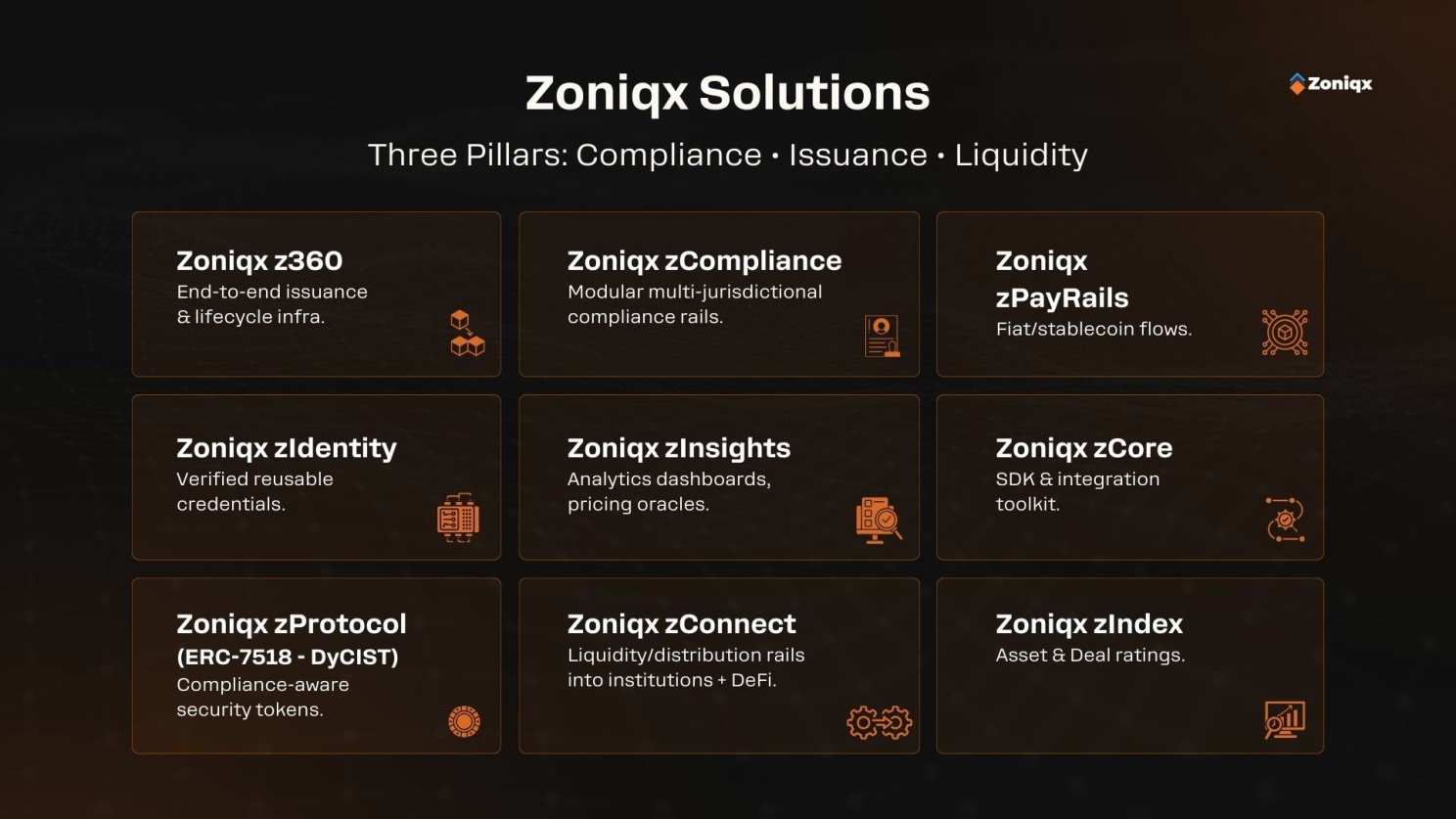
Zoniqx enables financial institutions, issuers, and platforms to integrate tokenization into existing regulated workflows, without assuming custody, liquidity, or intermediary risk.
To explore partnerships or tokenization initiatives, visit www.zoniqx.com/contact
Disclaimer
This article is for informational purposes only and does not constitute legal, financial, or regulatory advice. References to SEC are based on public statements and do not imply endorsement or legal interpretation. Readers are encouraged to consult with legal or regulatory professionals before engaging in asset tokenization. Zoniqx operates in full compliance with applicable laws and supports regulatory clarity in the tokenization ecosystem.