Why Tokenization Needs Infrastructure Built to Survive Regulation
The past few years have seen an explosion of tokenization “platforms” promising faster issuance, broader access, and programmable finance for real-world assets. Many launched quickly, attracted early traction, and marketed themselves as end-to-end solutions for asset issuers and investors alike.
But financial markets have a long memory, and regulation has an even longer one.
As regulatory scrutiny around digital assets intensifies globally, a familiar pattern is emerging. Market-facing platforms are being stress-tested first. Business models built on aggregation, custody assumptions, or implicit financial intermediation are discovering that scale and speed do not equate to durability.
In every financial cycle, one truth repeats: platforms launch, but infrastructure is what survives.
The Platform Fallacy in Tokenization
Many tokenization platforms are designed to simplify asset issuance and distribution by consolidating multiple functions, such as issuance workflows, compliance logic, investor onboarding, and distribution, into a single operating layer. While this approach reduces surface complexity, it concentrates regulatory and operational exposure.
Platforms that sit directly between assets and investors are subject to overlapping regulatory regimes, including securities regulation, custody requirements, market conduct rules, and cross-border compliance obligations. As these platforms scale, they begin to assume characteristics of regulated financial intermediaries, irrespective of their original intent.
This outcome is structural rather than execution-driven. Tokenization does not remove regulatory requirements; it reallocates them across the value chain. When platforms attempt to control multiple market functions simultaneously, they become focal points for regulatory scrutiny, often encountering jurisdictional conflicts, licensing constraints, and capital requirements. The resulting fragility reflects limits in the operating model rather than shortcomings in the underlying technology.
Regulation Is a Stress Test, Not a Surprise
In financial markets, regulation functions less as an external constraint and more as a mechanism for identifying concentrations of risk. As regulatory frameworks evolve, through asset classification, custody standards, or market infrastructure oversight, scrutiny tends to intensify where systemic exposure is greatest.
Market-facing platforms, by design, aggregate this exposure. They interact directly with investors, assets, funds, and transaction flows, and in doing so assume responsibility for outcomes across multiple regulatory dimensions.
Infrastructure is evaluated differently. It does not intermediate transactions, custody assets, or manage market participation. Instead, it provides technical enablement that allows regulated entities to operate within established legal frameworks with greater efficiency and consistency. When regulatory conditions change, infrastructure can adjust without requiring fundamental changes to market role or business scope, whereas platforms often must reassess their operating model entirely.
What True Infrastructure Looks Like
In financial markets, infrastructure is rarely visible to end users, and that is precisely why it lasts.
Stock exchanges, settlement systems, messaging standards, and market data rails have endured not because they owned the customer relationship, but because they were structurally indispensable. They enabled markets without attempting to become the market.
In tokenization, the same principle applies.
True tokenization infrastructure is:
- Neutral: It does not compete with its users or dictate market structure.
- Modular: It integrates into existing workflows rather than replacing them.
- Jurisdiction-aware but not jurisdiction-bound: Designed to support compliance across regulatory environments without hardcoding assumptions.
- Non-custodial and non-intermediating: It avoids holding assets, funds, or investor relationships.
- Built for longevity: Designed to evolve alongside regulation, not ahead of it.
This kind of infrastructure does not chase user growth or liquidity. Its value compounds as more regulated actors rely on it to operate safely at scale.
Infrastructure vs. Platform: A Structural Difference
The distinction between platforms and infrastructure is not semantic; it is architectural.
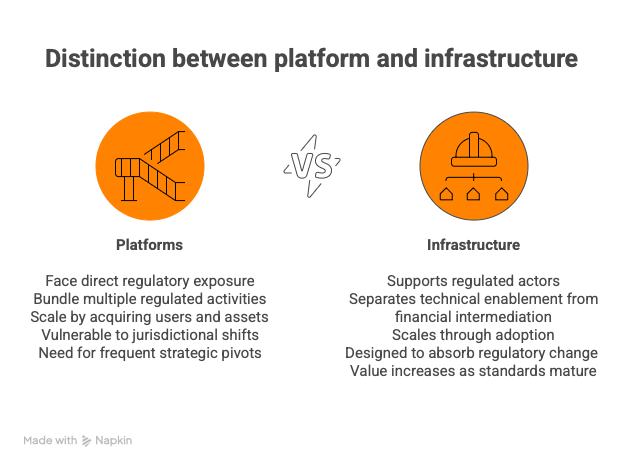
Platforms
- Face direct regulatory exposure
- Bundle multiple regulated activities
- Scale by acquiring users and assets
- Are vulnerable to jurisdictional shifts
- Often require frequent strategic pivots
Infrastructure
- Supports regulated actors without replacing them
- Separates technical enablement from financial intermediation
- Scales through adoption, not aggregation
- Absorbs regulatory change through design
- Becomes more valuable as standards mature
In regulated markets, longevity is not achieved through disruption alone. It is achieved through alignment.
Where Zoniqx Fits in the Tokenization Stack
Zoniqx is designed on the assumption that tokenization must operate within existing financial and regulatory frameworks to be viable at scale. Rather than functioning as a market-facing platform, it provides infrastructure that regulated entities can incorporate into their own products, workflows, and compliance environments.
This design choice is deliberate. By remaining infrastructure-focused, Zoniqx avoids the regulatory and operational exposure inherent in platform-based models, while enabling issuers, platforms, and financial institutions to tokenize assets without relinquishing control over custody, distribution, or regulatory accountability. Zoniqx does not seek to redefine market structure; it provides the technical foundation required for compliant operation as regulatory conditions evolve.
Why Infrastructure Compounds While Platforms Reset
Regulatory cycles tend to force platforms to reassess their scope, licensing posture, or market role. Some adjust. Others consolidate or withdraw. Infrastructure, by contrast, accumulates relevance over time.
As standards stabilize and institutional adoption increases, infrastructure becomes embedded within market operations. Its value is reinforced through reliability, regulatory confidence, and operational continuity rather than user acquisition. In tokenization, long-term relevance is therefore more likely to accrue to systems designed for regulatory alignment from the outset, rather than to those optimized for speed or early visibility.
The Sustainable Path Forward for Tokenization
Tokenization is increasingly being evaluated as an operational mechanism rather than a market narrative. Its relevance will be determined by whether it can integrate into existing legal, compliance, and market infrastructures without introducing new sources of risk.
In this context, attempts to position tokenization platforms as replacements for regulated institutions are unlikely to scale. Financial markets tend to adopt technologies that reinforce established governance structures, not those that circumvent them.
As regulatory frameworks continue to clarify, solutions that remain operationally neutral, structurally dependable, and legally interoperable are more likely to persist. These characteristics are typically found at the infrastructure layer, where technical enablement can evolve without altering market roles or regulatory responsibilities.
In tokenization, longevity is therefore less a function of innovation velocity and more a function of architectural alignment with regulation.
Conclusion
In regulated markets, what endures is not visibility but structure. Zoniqx exists at the infrastructure layer, designed to remain operational, compliant, and adaptable regardless of how platforms, narratives, or market cycles evolve.
Zoniqx can engage with your team to assess a specific asset class or jurisdictional footprint and map how its tokenization infrastructure, built on ERC-7518/DyCIST, can be integrated into your existing regulatory and operational framework; schedule a demo call to evaluate long-term fit.
About Zoniqx
Zoniqx (pronounced Zoh-nicks) is a Silicon Valley–headquartered fintech company building core infrastructure for regulated real-world asset (RWA) tokenization.
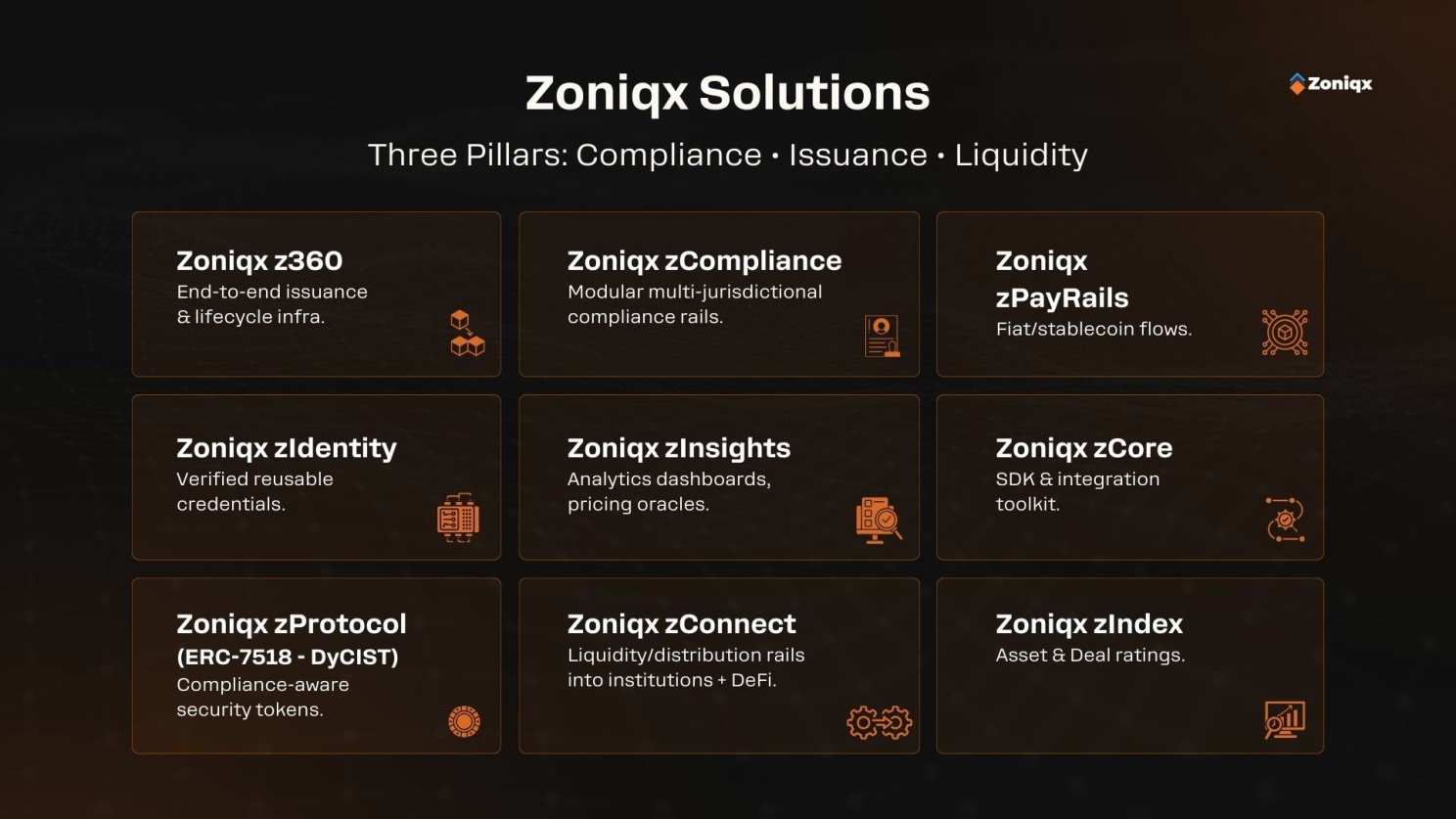
Its modular product suite, including z360, zCompliance, zPayRails, zConnect, zIdentity, zInsights, zIndex, and zProtocol built on DyCIST (ERC-7518), provides an interoperable, compliant, and chain-agnostic infrastructure layer supporting tokenization across public, private, and hybrid blockchains, and delivered through enterprise-grade SDKs and APIs.
Zoniqx enables financial institutions, issuers, and platforms to integrate tokenization into existing regulated workflows, without assuming custody, liquidity, or intermediary risk.
To explore partnerships or tokenization initiatives, visit www.zoniqx.com/contact
Disclaimer
This article is for informational purposes only and does not constitute legal, financial, or regulatory advice. References to SEC are based on public statements and do not imply endorsement or legal interpretation. Readers are encouraged to consult with legal or regulatory professionals before engaging in asset tokenization. Zoniqx operates in full compliance with applicable laws and supports regulatory clarity in the tokenization ecosystem.